
Century Club: The Black Side Edition
By Kellea Roberson, Preservation Intern
“The Black Side of Oakland Cemetery” is a phrase borrowed from appraised genealogist and historian Dr. D.L. Henderson. It notes how culturally rich the section of Oakland is as a repository of Black life in Atlanta. Many of Oakland’s centenarians are Black residents, who experienced successes, triumphs, trials and tribulations throughout their 10 decades of life. Black centenarians in Oakland are a diverse group of Atlantans who demonstrate exceptional courage, resilience, and perseverance and can further provide a culturally informed perspective of Atlanta history.
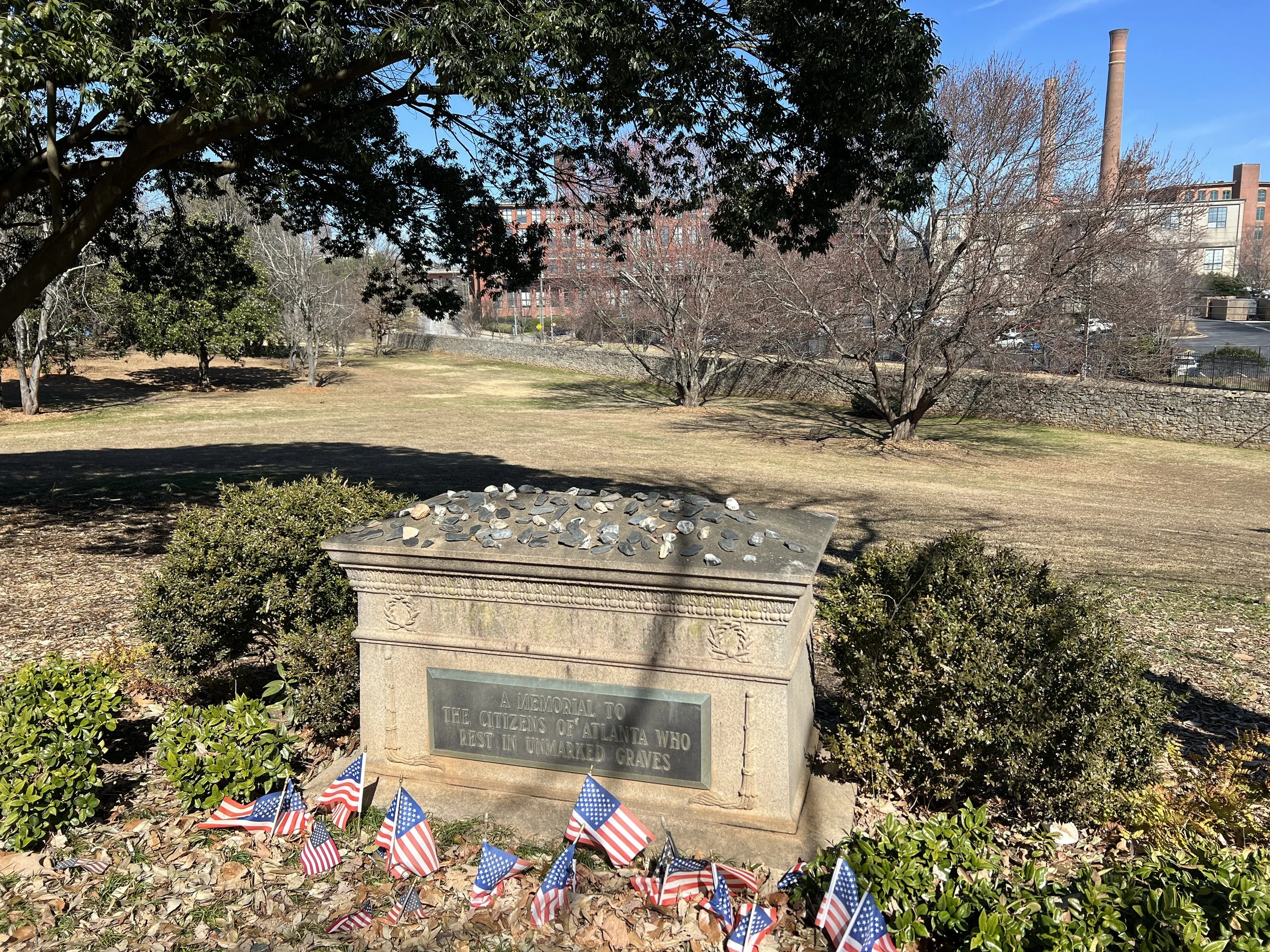
A Memorial to the Citizens of Atlanta Who Rest in Unmarked Graves in Oakland Cemetery’s Potter’s Field
The burial records revealed that over thirty possible centenarians were buried in Potter’s Field, a section of the cemetery designated for pauper burials. This group included Africans kidnapped from their home countries and sold within the Transatlantic slave trade, first-generation Americans of African descent born into slavery, enslaved people who became emancipated and gained American citizenship, first-generation free-born children and their descendants.
They’ve experienced slavery to emancipation, Reconstruction to Jim Crow, and throughout these periods, they witnessed and partook in the Civil Rights Movement and beyond. They lived through pivotal events that still affect our society today.
Although their names and sometimes the barest biographical data was recorded, we know very little about most of these individuals. Even their ages are in question due to illiteracy and dehumanizing effects of slavery. Recorded in these large ledger books are first and last names, interment dates, ages and causes of death, they are listed in between a mix of paid and assigned burials. Most of the names of those interred in Potter’s Field have been unspoken for nearly 150 years. With these upcoming blogs, I hope to shed light on some of the stories that have been overshadowed for all that time.
Giving a voice to these otherwise discarded stories is the goal of my next two blog posts. These individuals witnessed ten decades of a life where they had no choice but to reckon with the ills of society, and yet still they persisted. I'd be remiss if I didn’t acknowledge that so many names and lives are pushed to the background because our society’s tendency to amplify the famous and flashy. But it is the mundane that keeps the world turning and the ordinary that bears us into history. With that, I hope you enjoy learning of Celia Davis, a “Faithful Black Mammy,” as her epitaph states, one of the few individual headstones from Potter’s Field that Oakland still has today. I hope that reading the names of Hazer Low, Betty Winship, Sally Crawford and Joe Diggs, just a few of our Black centenarians in Potter’s Field, gives you a sense of meaning.
Although they don’t know it, many descendants can trace their history to Potter’s Field. We do not all have direct lines to the larger-than-life names that surface when we discuss Civil Rights and other moments in our collective history, but rather we must acknowledge that we have our own Martin Luther Kings, our own Rosa Parks. I ask you as a patron of Oakland’s grounds to remember that many souls in the Potter’s Field are utterly forgotten, and just briefly think of the socioeconomic and political conditions that created this section. Heavy as it may be, take time to be present with it. In the same manner as the rest of Oakland, Potter’s Field serves as a repository for the working class, and specifically for the Black working class of Atlanta.
Celia Davis
1780 - December 14, 1880
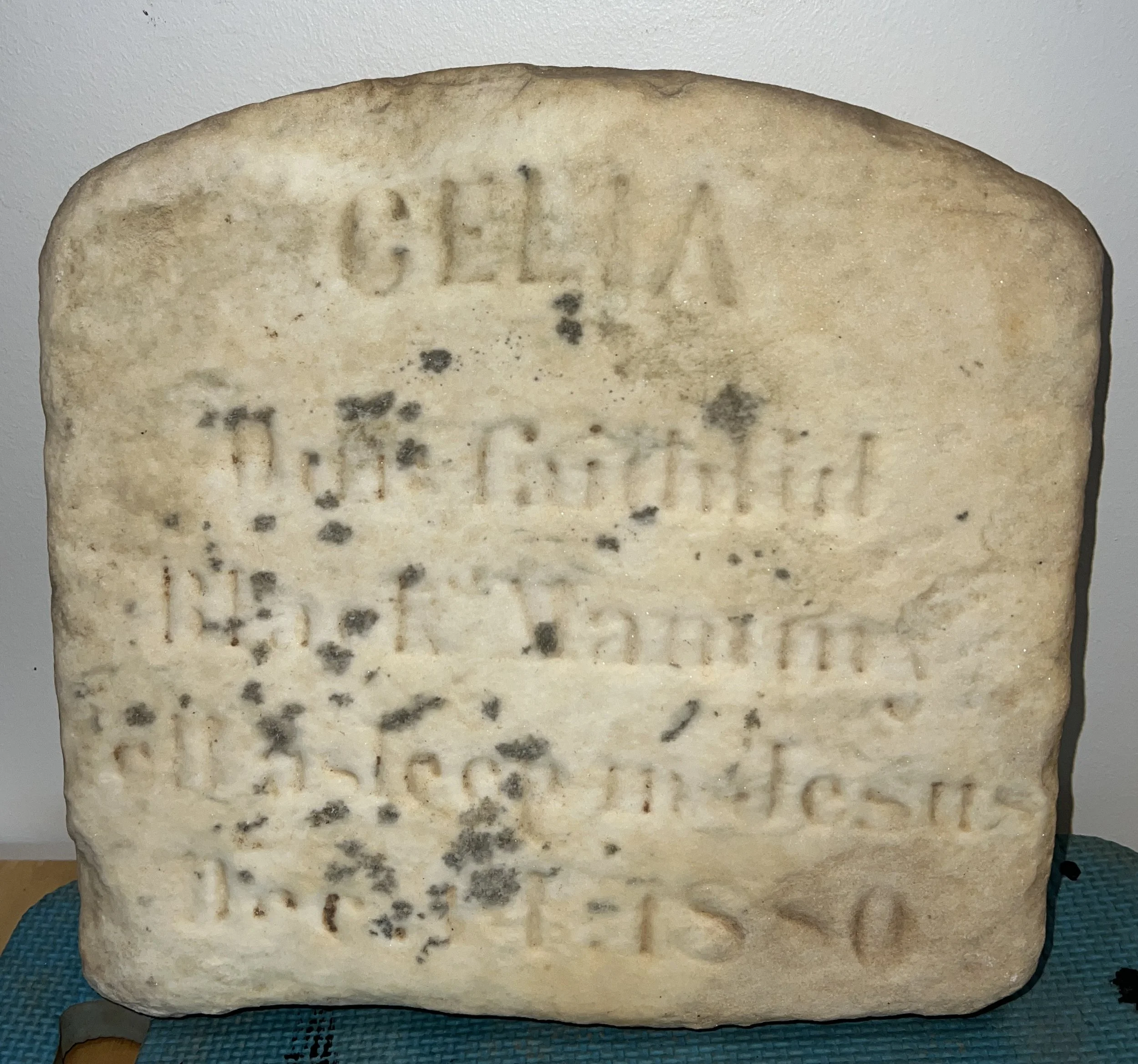
Celia Davis’ Headstone
“An Old Mammy’s Grave,” heads the brief section of Celia Davis’s mention in the 1907 Atlanta Constitution article discussing the state of Potter’s Field in Oakland Cemetery. An investigation of the condition of the grounds was currently underway, as cemetery committee members acknowledged the “worsening” state it was in.
With lots being washed away, walls crumbling down, monuments toppling over, and driveways in bad repair, Potter’s Field was in a state of disrepair, and the cemetery committee noted something needed to be done. At the time, Sexton Barefield lamented that he was doing the best he could with the “pitiful sum” of $1,000 the city budget allotted. Potter's Field gained special attention from the committee for its role as the spot to which “God’s poor” were laid to rest.
At the slope on the hill there is a ditch that frequent rains had washed out, that forms the only dividing line between the graves between a colored line. No inclination noted Potter’s Field, where thousands of dead lay to sleep. There is also no indication of the totality of all who are buried there; the 1907 article noted that “no record was made” when the poor were buried. “When they were buried, not a scratch of a pen, to show either name or date. When they were buried there all traces of them disappeared as completely as if they had found watery graves in mid-ocean.” Within this vast field of the sleeping dead there could be seen three or four stained and decaying stones. The article mentioned only one inscription of these stones, and it belongs to CELIA.
CELIA
Our Faithful Black Mammy
FELL ASLEEP IN JESUS
DECEMBER 14, 1880.
(Mrs. Joseph E. Brown)
The city sexton shared that many years ago, one-grave lots were sold in Potter’s Field for Black individuals, and the “old Black mammy” of the Brown family was one of them. Joseph E. Brown served as the governor of Georgia during the Civil War. Much is known about his life and legacy, but not of the domestic servant who served him and his family “faithfully”.
Within the burial records, Celia is recorded as Celia Davis, 100 years old and died from general debility, a gradual decline in overall physical health, which is not surprising at age 100. Within the last 10 years of her life, Celia was living with her daughter, her son-in-law and her grandson on Fair Chapel Street in Atlanta. Her daughter, Emma DeLamotta, was a school teacher at Spelman Seminary and her husband, Adophus DeLamotta was a minister.
Looking at the few details we have on the life of Celia, I can only hope Celia's last few years were filled with time spent with rest, time spent with her family, and peace. Though the details of her life are wrapped up in her role in service to a white family, I know her 100 years meant much more than that. Her life was defined by her nurturing spirit and loving character, her ability to be resilient and forthcoming even within a society that only saw her as a “faithful black mammy”.
