How Interning at Oakland Changed the Paths of Two Preservation Interns
Oakland’s Preservation and Restorations Team has a straightforward goal — restoring 48 acres of Atlanta history, stories, and monuments. But their work also offers an opportunity for emerging professionals to learn and gain hands-on field experience.
During their time at Oakland, Preservation Interns learn from experts, collaborate with Oakland’s grounds team, and apply their skills towards complex restoration projects.
Keep reading to hear directly from two of Oakland’s recent Preservation Interns, Bethany Girard (now a full-time staff member) and Ava Carubia, as they reflect on how they grew as both individuals and professionals during their time at Oakland.
By Bethany Girard, Preservation Technician I
As I near my first anniversary as a Preservation Technician at Historic Oakland Foundation, I have been reflecting on what led me to have the opportunity to call myself an Oakland employee.
During the summer of 2024, I was the Preservation Intern, a two-month stint that changed the trajectory of my life. I've thought about all the things that I learned in those short two months: the projects I worked on, but mostly I’ve thought about the project that truly solifidied my passion for historic preservation. The restoration of R.E. Jackson’s headstone was the most complex and detail-oriented project of my internship. R.E. Jackson was born January 18th 1852, in Albemarle Co, Virginia. He moved to Atlanta with his parents while he was still young. He lived on South Pryor Street with his family until his passing on July 13th, 1875. R.E. Jackson worked for Chamberlin Boynton & Co as a clerk for 8 years and he was described as a “model and popular young man.”
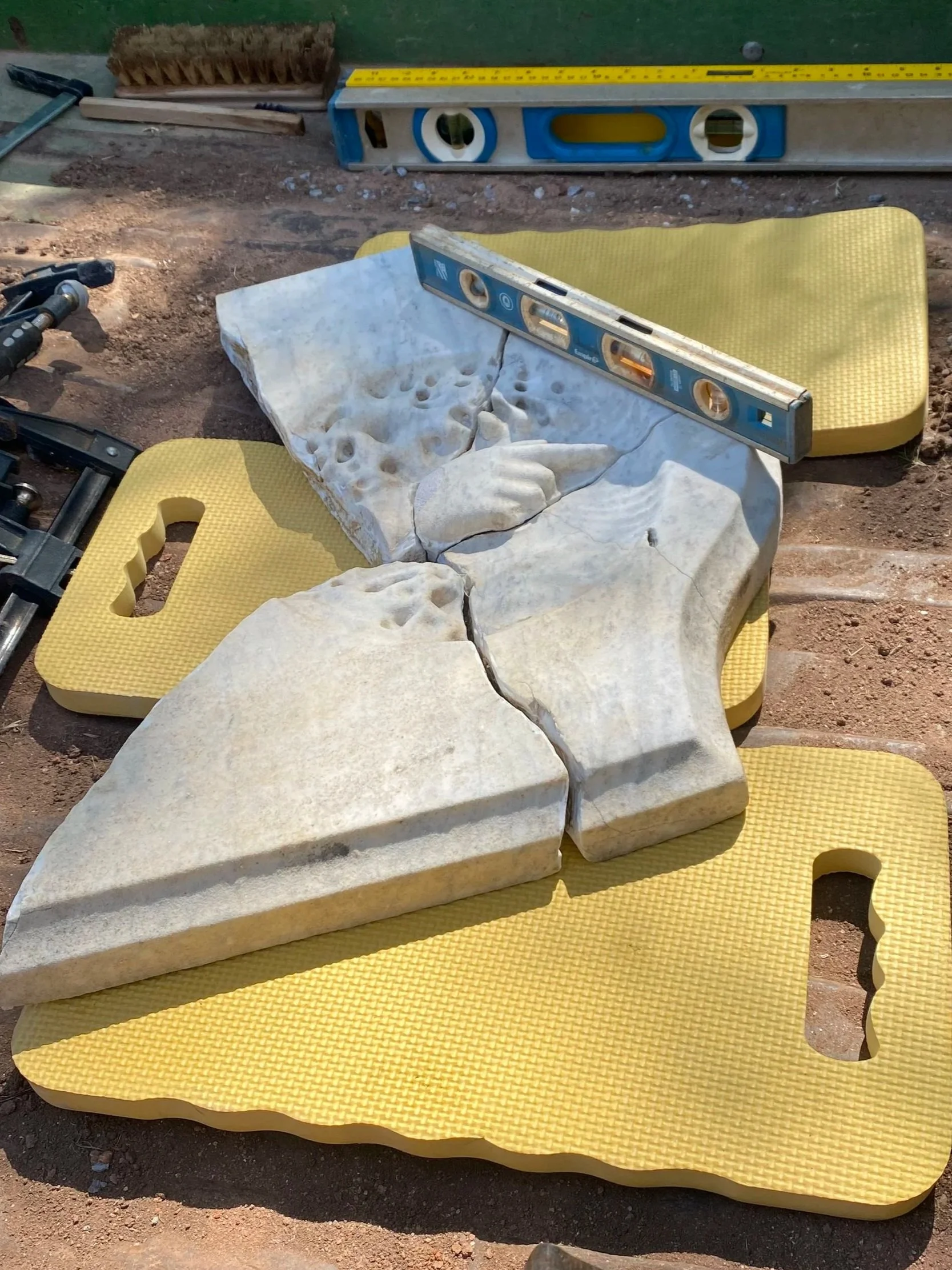
Broken headstone of R.E. Jackson.
Repairing Jackson’s headstone was by far my favorite part of my internship. It was an intricate and detailed process, which is my favorite type of work. According to notes on the burial abstract, the headstone was previously broken and repaired in 1982. Luckily, whoever repaired it in 1982 did not insert metal pins in the stone during its repair — they only used epoxy and mortar to reset the broken pieces. (I say 'luckily' because the lack of pins meant that when the stone broke again, it broke in the same places it had in 1982.) This left us with clean breaks rather than new breaks or stone shattering, which commonly occurs when rigid pins are placed into a headstone.
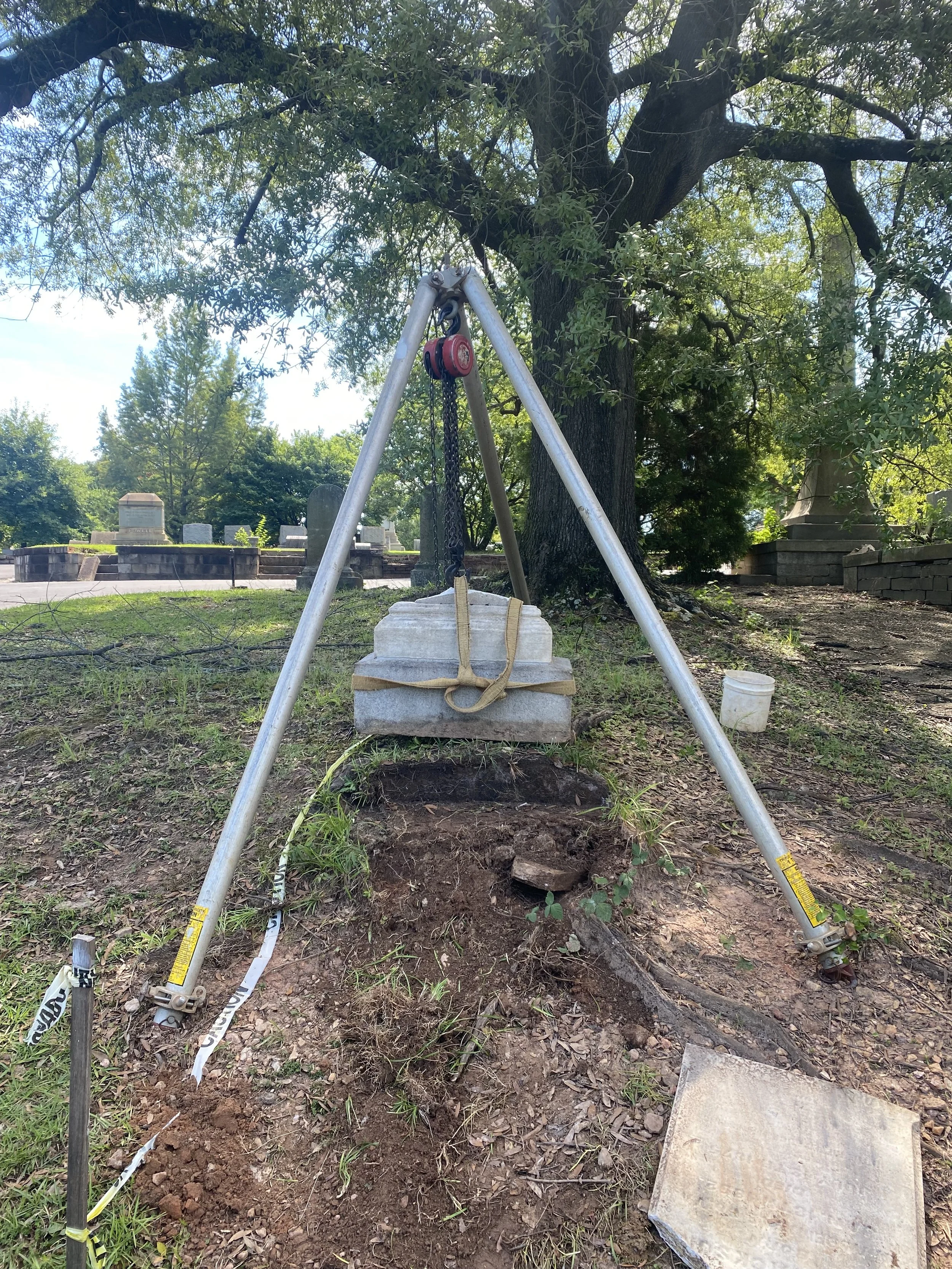
Tripod used to lift base of headstone.
When we began this project, I started by cleaning all of the individual pieces of the stone with D2. Then, we used a tripod and lifting equipment to remove the base of the headstone because it was no longer sitting level.
When we removed the base, we quickly realized there was a large tree root pushing up on the base of the headstone, causing it to become out of line and unlevel. We consulted with one of the gardeners, who let us know it was safe to cut that root. To help further mitigate any future root issues, we built a form and poured a small concrete base for the stone to be reset upon.
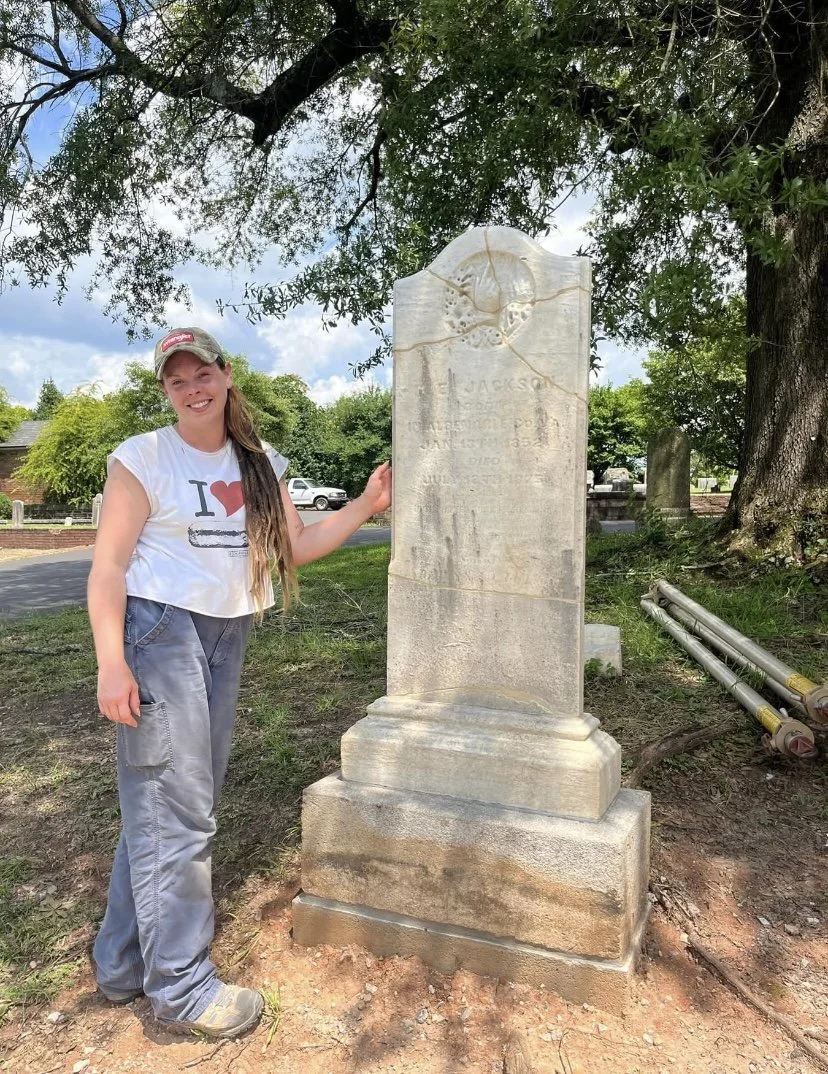
Bethany Girard next to R.E. Jackson's newly restored headstone.
Once the concrete hardened, we reset the base of the headstone and then got to work repairing the headstone's pieces.
I wire brushed off the old epoxy, and Mike, the Preservation Specialist, used a rotary tool to shape the edges of the various breaks to allow for the new mortar to fill the cracks. We applied epoxy to the broken stone pieces and started piecing them back together like a stone puzzle.
We used levels and clamps to ensure that the stone was secure and level. Then, once the epoxy had cured, it was time for the fill. We used a lime mortar and added pigments to color-match the repair to the weathered stone. When I was done filling the cracks with the new mortar, I covered them with a damp canvas and a tarp to ensure that the fill would cure properly. This project showed me just how much time, energy, and technique go into a complex repair like this. The completion of R.E. Jackson's headstone repair is a project I am very proud of, and it's the project that solidified my desire to make the transition from Historic Oakland Foundation intern to employee.
By Ava Carubia, Preservation Intern
During my preservation internship at Oakland in 2023, I spent hours in the hot sun learning how to reset headstones.
I learned how to rebuild a historic brick wall on the east side of the cemetery with its original bricks. One of my favorite projects involved repairing a cracked headstone with epoxy, mortar, and a Dremel, practicing the precise movements it takes to cut a rock with a sharp blade.
That summer, I learned how to notice. Ashley Shares, Oakland’s Director of Preservation, taught me the difference between granite, marble, and concrete headstones. She identified bricks throughout the cemetery that were made by companies that used convict leasing after the Civil War. We reflected on the Cemetery’s past segregation and Confederate monuments. We toured South-View Cemetery and Atlanta History Center’s archives. As someone born and raised in Ormewood Park, connecting the physical structures of the cemetery to the Atlanta I knew was transformative.
It revealed that the city’s history is messy and often full of contradictions. It showed me that without cemeteries and burial records, the lives and stories of so many people are unmarked.
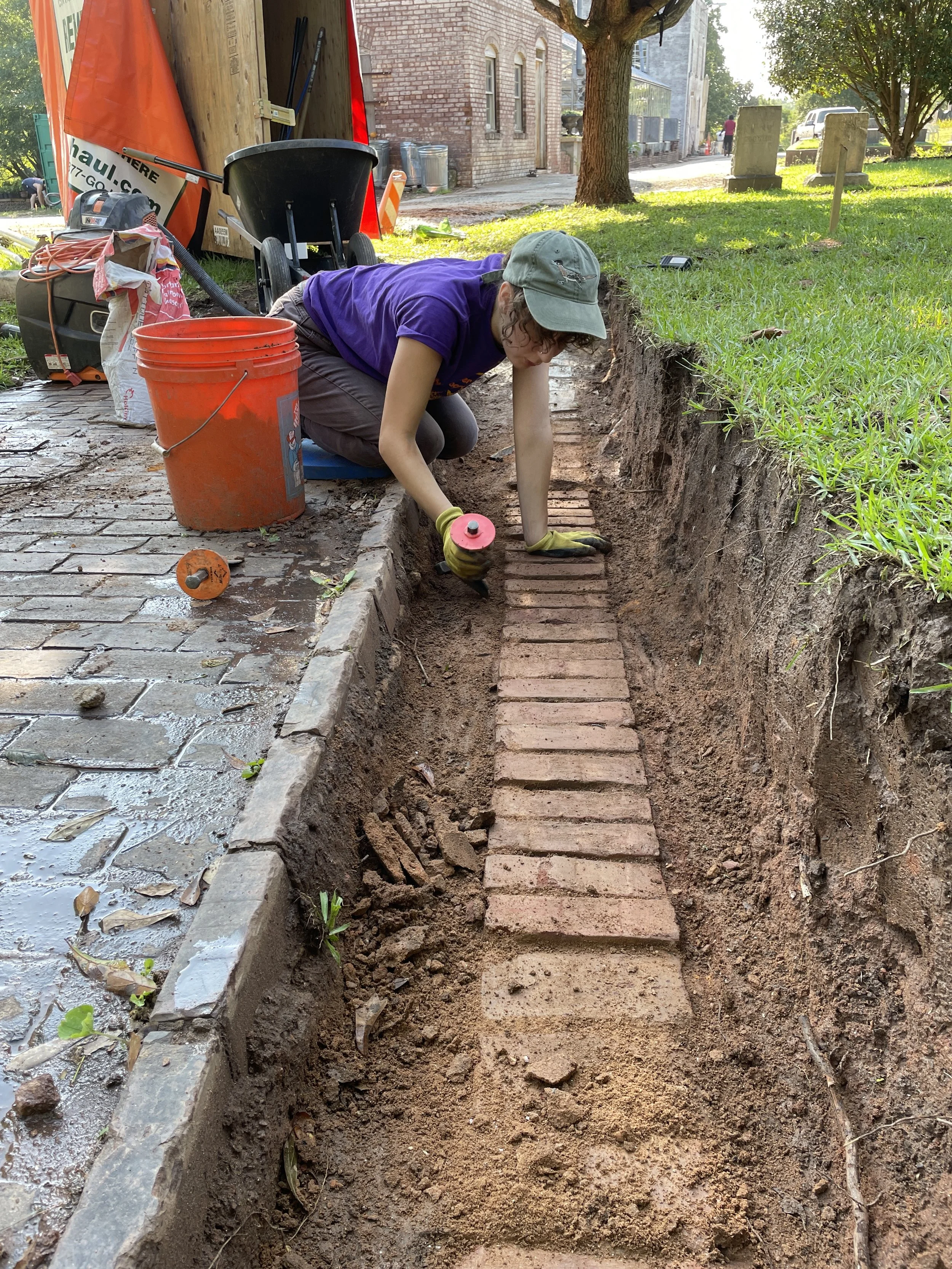
Preservation Intern Ava Carubia rebuilding the east side historic brick wall.
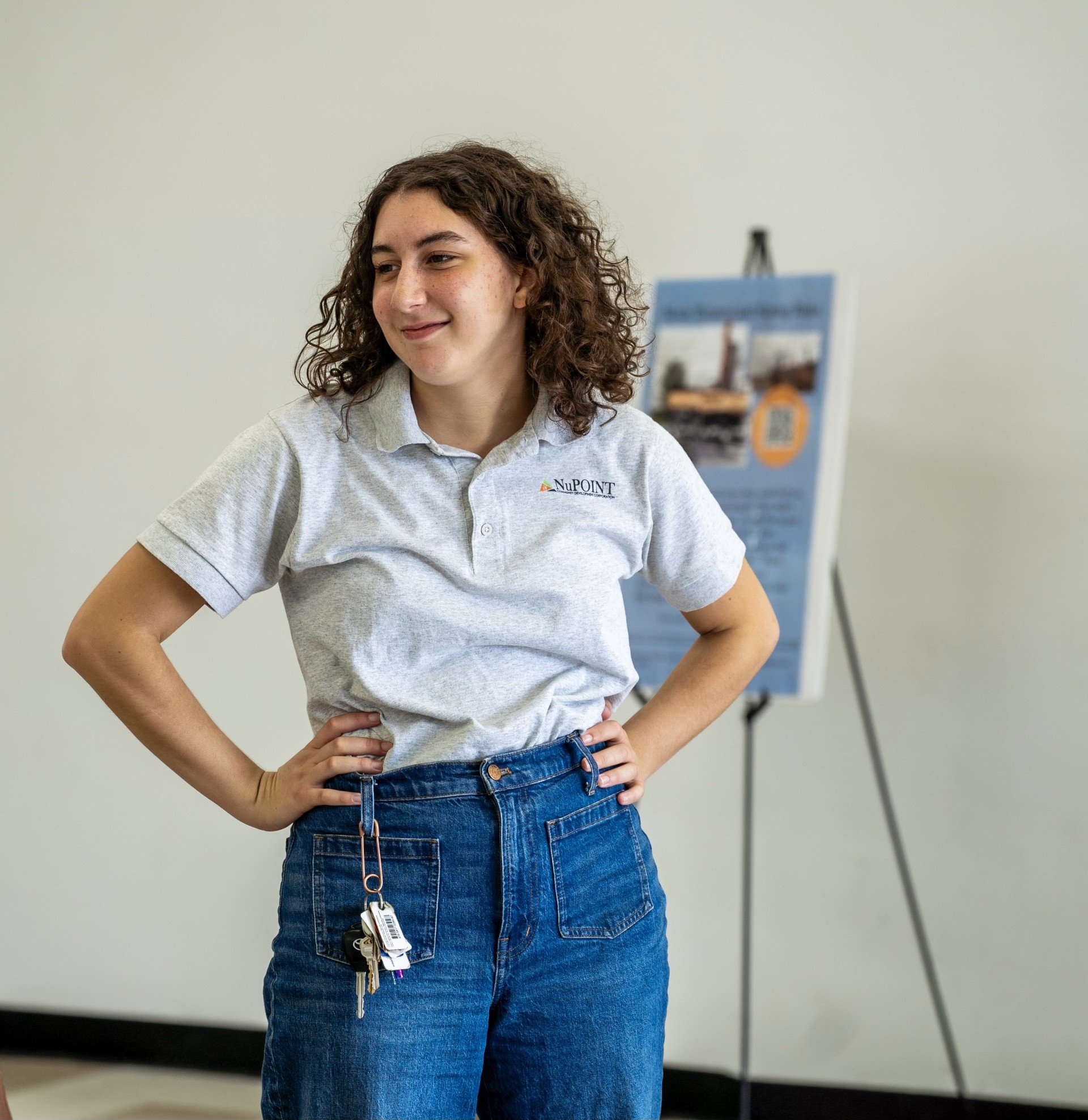
After my internship at Oakland, I graduated from Oberlin College in 2024 with a B.A in History. I moved to Cleveland, Ohio, where I created a public history project documenting the history of the southeast side of the city. I currently work two roles — one at a nonprofit that connects people to the Ohio & Erie Canalway National Heritage area; the other at the Baseball Heritage Museum, which retells baseball history both locally and beyond.
Monuments, buildings, headstones, and brick walls — they all tell a deeper story of place. At Oakland, I learned in very real, visceral ways how history is all around us. I learned the care required to restore the structures that we often take for granted: those reminders of our collective past that affect our collective present. Living in a city like Cleveland that has seen significant deindustrialization and population loss has made me understand, even more acutely, the importance of preservation.
Before working at Oakland as an intern, I thought that cemeteries were fixed. I thought that headstones stayed rooted; that history was cemented in the past. The work I did that summer, both on the grounds and in the archives, truly taught me that history is alive. It solidified my interest in careers that connect people to the history of their communities. It gave me the tools to communicate why this history matters and why it must not be lost.